
Why Dream Symbols Differ From Person to Person
Why does the same dream symbol mean different things to different people? Personal memory, feeling and context shape a symbol more than any dictionary entry.
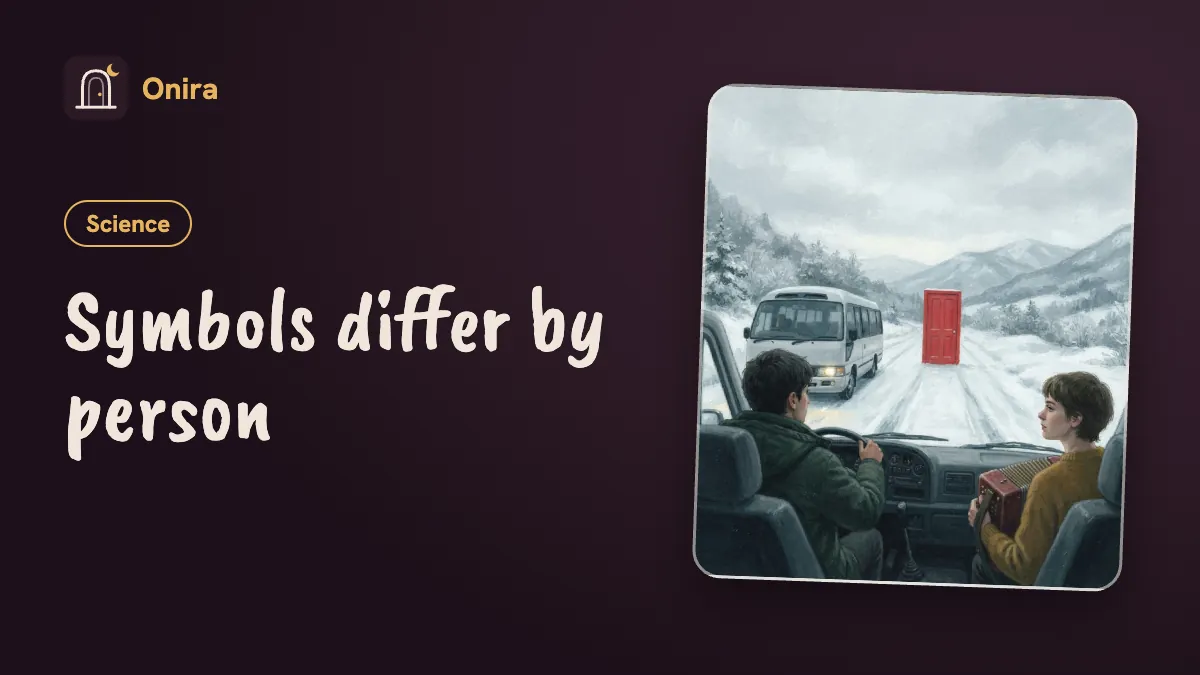
A dream symbol is an image, figure or event in a dream that stands for more than itself, such as a house, an animal or a staircase. This post explains why the same symbol carries different weight for different people, and what to do with that when you read your own dreams.
What is a dream symbol?
A symbol is an image that gathers a feeling around it. A door in a dream is a door, but it is also whatever opening, closing or waiting the dreamer is living through. The image is the visible part; the feeling and context are what give it weight.
Popular books treat symbols as entries: snake means this, water means that. The psychological view starts from the other end. It asks what the image calls up in you and why it appeared now. If you want to see how this works on specific images, the dream symbols guide sets out one psychological view for each.
Why does the same image feel different to different people?
Think of two people who both dream of a snake. One grew up near fields and learned to watch where she stepped; the snake brings caution and respect. The other has never met one outside a screen; the snake brings a jolt of fear. Same image, two different dreams.
The difference lies in personal history. Every image is stored with the moments in which you met it: a story from a grandparent, a film, a day at a lake. When a dream draws on that store, the feeling comes along with the image. This is why two readings of one symbol cannot be swapped.
What does dream research say?
Content analysis of large collections of dream reports finds that dreams are not random. A review of this work by G. William Domhoff reports that what appears in dreams tracks a person's concerns and relationships in waking life (Source 1). A study by Michael Schredl and Frank Hofmann, which compared diary records of daily activities with dream reports, found continuity between the two: activities that fill the day tend to show up in dreams (Source 2).
This does not mean every image has an easy lookup. It means that the best clue to a symbol is usually your own recent life, which is exactly the material a dictionary cannot have. For a broader account of the field, the book Researching Dreams gives an overview of methods and findings (Source 3).
Are some images shared by many people?
Yes, some themes are reported widely. People in many places describe dreams of falling, of being chased or of a familiar house. Researchers often call these common dream themes.
A common theme is not a common meaning. Two people who dream of falling can be feeling very different things: one the dread of losing control at work, the other a plain sense of letting go after a long week. What is shared is the shape of the scene; what differs is everything attached to it. Treat frequency as a reason the image is easy to recognise, not as proof of what it says.
How do you read your own symbol?
A simple routine keeps the reading yours.
Start with the feeling, because it is the most reliable part of a dream you can name. Then place the image beside what you were living. Only then, if you like, read an entry and see whether any line fits. Where it does not fit, leave it.
A record helps more than any single dream. When you write dreams down over weeks, you can see which images return and what they return with, as the dream journal guide explains. The five steps in how to interpret your dreams then give the order in which to read each one.
What should you avoid?
Avoid treating a symbol as a verdict. A dream image tells you nothing about the future, other people's intentions, your health or your money; it is a way of noticing your own inner world. Avoid also the opposite mistake of ignoring a strong image because it is common. A common image can still be personal.
How does Onira handle symbols?
Onira reads each dream with the feeling and context you give it, so the same image can be reflected on differently for different people. Over time the Insights screen gathers the symbols that recur in your own record, which makes your personal pattern visible. You can look at the features or start from the download page.
Frequently asked questions
Do dream symbols have a universal meaning?
Not in a way research has shown. Some themes, such as falling or being chased, are reported by many people in many places, but what they stand for is tied to the dreamer's own feelings and life. A shared image does not carry a shared meaning.
Why do I dream of the same symbol again and again?
A symbol that returns is often tied to something that keeps your attention while you are awake. Writing down the feeling each time, and what was happening in your days, shows what the image is attached to for you.
Is a dream symbol dictionary useless?
A dictionary is a fine place to collect questions, but it is a poor place to stop. Use an entry as a prompt, then check it against your own memory and feeling. If the entry does not fit you, leave it.
Get started
Tell your own dream in Onira.
Get your reflection and your scene sequence.
Sources
- American Psychological Association (2003). The Scientific Study of Dreams: Neural Networks, Cognitive Development, and Content Analysis
- Consciousness and Cognition (2003). Continuity between waking activities and dream activities
- Palgrave Macmillan (2018). Researching Dreams: The Fundamentals
Keep reading
How to Interpret Your Dreams: A 5-Step Method
How do you interpret a dream? Start with the feeling, then add context, the key image and the questions to ask yourself, in five plain steps.
How to Keep a Dream Journal: A Step-by-Step Guide
How do you keep a dream journal? A plain guide from putting a notebook by the bed to noting feelings and tracking recurring symbols. Start today.
Dream Dictionaries vs. Psychological Interpretation
Dream dictionaries list fixed meanings; psychological interpretation starts from you. Compare the two approaches and learn which questions to ask of a dream.